
Spring MVC is a web framework built on top of the Spring Framework. It helps developers create web applications and REST APIs using the Model-View-Controller (MVC) architectural pattern.
In this tutorial, we will introduce Spring MVC, explore its main components, and understand how an HTTP request is processed.
1. What is Spring MVC?
Spring MVC is part of the Spring Framework and provides a structured way to handle HTTP requests, process application logic, and generate responses.
It follows the Model-View-Controller pattern, which separates an application into three main responsibilities:
- Model: Represents application data and business information.
- View: Displays information to users, typically as HTML.
- Controller: Receives HTTP requests and coordinates the application’s response.
This separation makes applications easier to develop, maintain, and test.
Spring MVC can also build REST APIs that return JSON instead of HTML.
2. How does Spring MVC work?
The central component of Spring MVC is the DispatcherServlet. It acts as a front controller that receives incoming HTTP requests and delegates them to the appropriate controller.
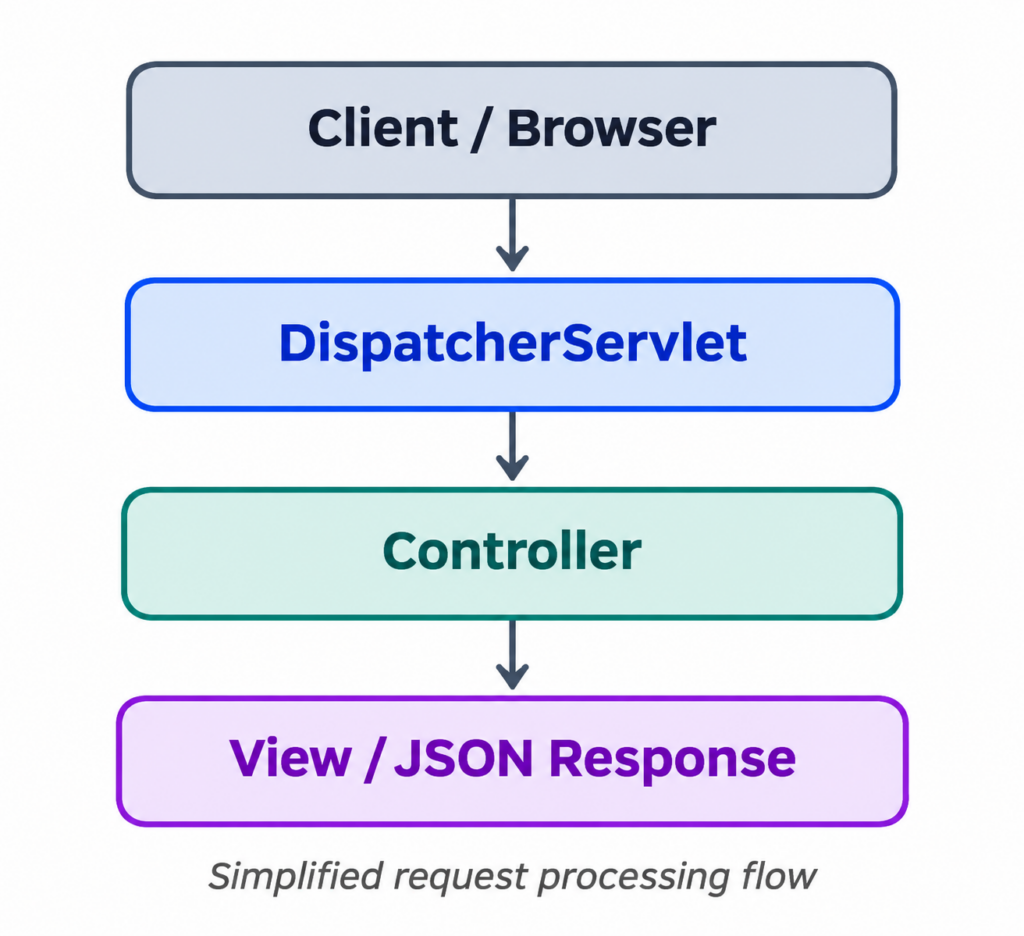
When a browser sends an HTTP request, Spring MVC performs the following steps:
- The
DispatcherServletreceives the request. - Spring MVC identifies the appropriate controller method.
- The controller processes the request, often calling application services.
- The controller returns data or a view name.
- Spring MVC generates an HTTP response.
For HTML pages, a view resolver can help locate the appropriate view template. For REST APIs, an HTTP message converter can serialize Java objects into JSON.
3. Creating a simple Spring MVC controller
Let’s look at a simple controller that returns a greeting.
package org.kodejava.springmvc;

import org.springframework.web.bind.annotation.GetMapping;
import org.springframework.web.bind.annotation.RestController;

@RestController
public class HelloController {

    @GetMapping("/hello")
    public String sayHello() {
        return "Hello, Spring MVC!";
    }
}
The example uses two important annotations:
@RestControllertells Spring that the class handles web requests and writes return values directly to the HTTP response body.@GetMapping("/hello")maps HTTP GET requests for/helloto thesayHello()method.
When the application is properly configured and running, accessing /hello returns:
Hello, Spring MVC!
This controller is only one part of a Spring MVC application. We still need to configure the application context and register the DispatcherServlet before it can handle requests.
We will implement these components in the next tutorial.
4. Spring MVC vs. Spring Boot
Spring MVC and Spring Boot are related, but they serve different purposes.
| Spring MVC | Spring Boot |
|---|---|
| Web application framework | Application configuration and bootstrapping |
| Provides controllers and request mappings | Provides auto-configuration |
| Can be configured manually | Simplifies application setup |
| Supports HTML and REST APIs | Can run Spring MVC with an embedded server |
Spring Boot does not replace Spring MVC. Instead, Spring Boot can configure and run Spring MVC applications with less setup.
5. Summary
In this tutorial, we learned that Spring MVC is a web framework based on the MVC architectural pattern. We also introduced the DispatcherServlet, explored the request processing flow, and created a simple REST controller.
In the next tutorial, How do I create my first Spring MVC application?, we will build a complete application using Java configuration and Maven.
6. Maven Dependencies
This series uses Spring Framework 7.0.10, the latest stable 7.0 release verified for November 10, 2026. Spring Framework 7.1 is still in its release-candidate stage.
Add the following dependency to your Maven pom.xml:
<dependency>
    <groupId>org.springframework</groupId>
    <artifactId>spring-webmvc</artifactId>
    <version>7.0.10</version>
</dependency>
The dependency provides Spring MVC’s core functionality. A runnable web application will additionally need a compatible Jakarta Servlet environment, which we will configure later in this series.