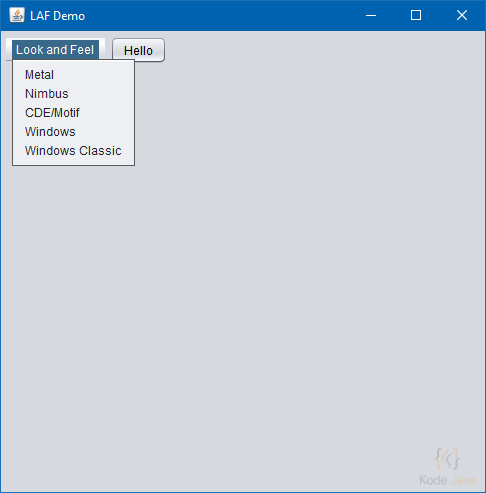
How do I set the look and feel for Swing application?

package org.kodejava.swing;

import javax.swing.JButton;
import javax.swing.JFrame;
import javax.swing.JMenu;
import javax.swing.JMenuBar;
import javax.swing.JMenuItem;
import javax.swing.SwingUtilities;
import javax.swing.UIManager;
import javax.swing.WindowConstants;
import java.awt.FlowLayout;

public class LookAndFeelDemo extends JFrame {
    public LookAndFeelDemo() {
        initComponents();
    }

    public static void main(String[] args) {
        SwingUtilities.invokeLater(() -> new LookAndFeelDemo().setVisible(true));
    }

    private void initComponents() {
        setSize(500, 500);
        setTitle("LAF Demo");
        setDefaultCloseOperation(WindowConstants.EXIT_ON_CLOSE);
        getContentPane().setLayout(new FlowLayout(FlowLayout.LEFT));

        JMenu menu = new JMenu("Look and Feel");

        // Get all the available look and feel that we are going to use for
        // creating the JMenuItem and assign the action listener to handle
        // the selection of menu item to change the look and feel.
        UIManager.LookAndFeelInfo[] lookAndFeels = UIManager.getInstalledLookAndFeels();
        for (UIManager.LookAndFeelInfo lookAndFeelInfo : lookAndFeels) {
            JMenuItem item = new JMenuItem(lookAndFeelInfo.getName());
            item.addActionListener(event -> {
                try {
                    // Set the look and feel for the frame and update the UI
                    // to use a new selected look and feel.
                    UIManager.setLookAndFeel(lookAndFeelInfo.getClassName());
                    SwingUtilities.updateComponentTreeUI(this);
                } catch (Exception e) {
                    e.printStackTrace();
                }
            });
            menu.add(item);
        }

        JMenuBar menuBar = new JMenuBar();
        menuBar.add(menu);

        getContentPane().add(menuBar);
        getContentPane().add(new JButton("Hello"));
    }
}
Java Swing Look and Feel (LAF)
Java Swing Look and Feel (LAF)

How do I get the available Swing look and feel?

The code snippet below describe how we can obtain the available look and feel in the current Swing platform. This information can then be made available to the user, so they can change to look and feel of the application in their preferences.

package org.kodejava.swing;

import javax.swing.UIManager;

public class AvailableLookAndFeel {
    public static void main(String[] args) {
        UIManager.LookAndFeelInfo[] lookAndFeels = UIManager.getInstalledLookAndFeels();

        for (UIManager.LookAndFeelInfo lookAndFeel : lookAndFeels) {
            // Get the name of the look and feel
            String name = lookAndFeel.getName();
            System.out.println("Name      = " + name);

            // Get the implementation class for the look and feel
            String className = lookAndFeel.getClassName();
            System.out.println("ClassName = " + className);
        }
    }
}

Below is the list of available look and feel produces by the code snippet above.

Name      = Metal
ClassName = javax.swing.plaf.metal.MetalLookAndFeel
Name      = Nimbus
ClassName = javax.swing.plaf.nimbus.NimbusLookAndFeel
Name      = CDE/Motif
ClassName = com.sun.java.swing.plaf.motif.MotifLookAndFeel
Name      = Windows
ClassName = com.sun.java.swing.plaf.windows.WindowsLookAndFeel
Name      = Windows Classic
ClassName = com.sun.java.swing.plaf.windows.WindowsClassicLookAndFeel

How do I format JTextField text to uppercase?

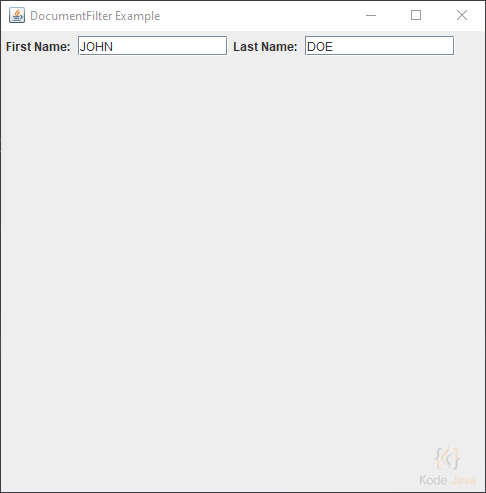
To change JTextField text to upper case can be easily done by adding a DocumentFilter to the JTextField component using the setDocumentFilter() method. The DocumentFilter allow us to filter action for changes in the document such as insert, replace and remove.

The code snippet below show us how to do it.

package org.kodejava.swing;

import javax.swing.JFrame;
import javax.swing.JLabel;
import javax.swing.JTextField;
import javax.swing.SwingUtilities;
import javax.swing.WindowConstants;
import javax.swing.text.AbstractDocument;
import javax.swing.text.AttributeSet;
import javax.swing.text.BadLocationException;
import javax.swing.text.DocumentFilter;
import java.awt.Dimension;
import java.awt.FlowLayout;
import java.awt.HeadlessException;

public class DocumentFilterExample extends JFrame {
    public DocumentFilterExample() throws HeadlessException {
        initComponents();
    }

    public static void main(String[] args) {
        SwingUtilities.invokeLater(() -> new DocumentFilterExample().setVisible(true));
    }

    protected void initComponents() {
        setSize(500, 500);
        setTitle("DocumentFilter Example");
        setDefaultCloseOperation(WindowConstants.EXIT_ON_CLOSE);
        getContentPane().setLayout(new FlowLayout(FlowLayout.LEFT));

        JTextField firstName = new JTextField();
        firstName.setPreferredSize(new Dimension(150, 20));
        JTextField lastName = new JTextField();
        lastName.setPreferredSize(new Dimension(150, 20));

        DocumentFilter filter = new UppercaseDocumentFilter();
        AbstractDocument firstNameDoc = (AbstractDocument) firstName.getDocument();
        firstNameDoc.setDocumentFilter(filter);

        AbstractDocument lastNameDoc = (AbstractDocument) lastName.getDocument();
        lastNameDoc.setDocumentFilter(filter);

        getContentPane().add(new JLabel("First Name: "));
        getContentPane().add(firstName);
        getContentPane().add(new JLabel("Last Name: "));
        getContentPane().add(lastName);
    }

    static class UppercaseDocumentFilter extends DocumentFilter {
        @Override
        public void insertString(DocumentFilter.FilterBypass fb, int offset, String text, AttributeSet attr)
            throws BadLocationException {
            fb.insertString(offset, text.toUpperCase(), attr);
        }

        @Override
        public void replace(DocumentFilter.FilterBypass fb, int offset, int length, String text, AttributeSet attrs)
            throws BadLocationException {
            fb.replace(offset, length, text.toUpperCase(), attrs);
        }
    }
}
JTextField Uppercase Text

JTextField Uppercase Text

How do I add key listener event handler to JTextField?

In this small Swing code snippet we demonstrate how to use java.awt.event.KeyAdapter abstract class to handle keyboard event for the JTextField component. The snippet will change the characters typed in the JTextField component to uppercase.

A better approach for this use case is to use the DocumentFilter class. See the following code snippet How do I format JTextField text to uppercase?.

package org.kodejava.swing;

import javax.swing.JFrame;
import javax.swing.JLabel;
import javax.swing.JTextField;
import javax.swing.SwingUtilities;
import javax.swing.WindowConstants;
import java.awt.Dimension;
import java.awt.FlowLayout;
import java.awt.HeadlessException;
import java.awt.event.KeyAdapter;
import java.awt.event.KeyEvent;

public class UppercaseTextFieldDemo extends JFrame {
    public UppercaseTextFieldDemo() throws HeadlessException {
        initComponents();
    }

    public static void main(String[] args) {
        SwingUtilities.invokeLater(() -> new UppercaseTextFieldDemo().setVisible(true));
    }

    protected void initComponents() {
        // Set default form size, closing event and layout manager
        setSize(500, 500);
        setTitle("JTextField Key Listener");
        setDefaultCloseOperation(WindowConstants.EXIT_ON_CLOSE);
        getContentPane().setLayout(new FlowLayout(FlowLayout.LEFT));

        // Create a label and text field for our demo application and add the
        // component to the frame content pane object.
        JLabel usernameLabel = new JLabel("Username: ");
        JTextField usernameTextField = new JTextField();
        usernameTextField.setPreferredSize(new Dimension(150, 20));
        getContentPane().add(usernameLabel);
        getContentPane().add(usernameTextField);

        // Register a KeyListener for the text field. Using the KeyAdapter class
        // allow us implement the only key listener event that we want to listen,
        // in this example we use the keyReleased event.
        usernameTextField.addKeyListener(new KeyAdapter() {
            public void keyReleased(KeyEvent e) {
                JTextField textField = (JTextField) e.getSource();
                String text = textField.getText();
                textField.setText(text.toUpperCase());
            }
        });
    }
}
JTextField Key Listener

JTextField Key Listener

How do I change JFrame image icon?

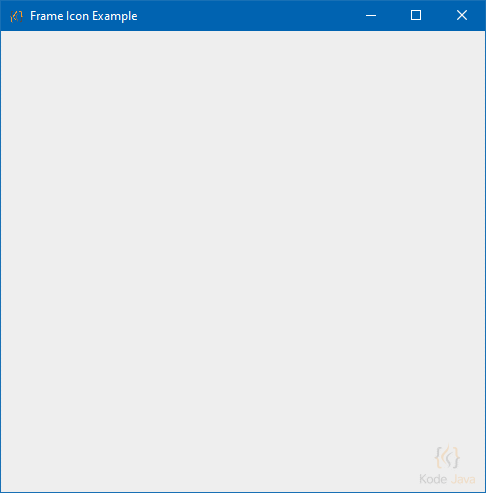
This code snippet demonstrates how to change a JFrame image icon using the setIconImage() method.

package org.kodejava.swing;

import javax.imageio.ImageIO;
import javax.swing.JFrame;
import javax.swing.WindowConstants;
import java.awt.Dimension;
import java.awt.image.BufferedImage;
import java.io.IOException;
import java.net.URL;

public class FrameIconExample extends JFrame {
    public static void main(String[] args) {
        FrameIconExample frame = new FrameIconExample();
        frame.setDefaultCloseOperation(WindowConstants.EXIT_ON_CLOSE);

        // Set the window size and its title
        frame.setSize(new Dimension(500, 500));
        frame.setTitle("Frame Icon Example");

        // Read the image that will be used as the application icon.
        // Using "/" in front of the image file name will locate the
        // image at the root folder of our application. If you don't
        // use a "/" then the image file should be on the same folder
        // with your class file.
        try {
            URL resource = frame.getClass().getResource("/logo.png");
            BufferedImage image = ImageIO.read(resource);
            frame.setIconImage(image);
        } catch (IOException e) {
            e.printStackTrace();
        }

        // Display the form
        frame.setVisible(true);
    }
}
Change JFrame Image Icon

Change JFrame Image Icon