How do I unpack an ISO 8583 message?

The code snippet below will show you how to unpack ISO 8583 message.

package org.kodejava.jpos;

import org.jpos.iso.ISOException;
import org.jpos.iso.ISOMsg;
import org.jpos.iso.packager.GenericPackager;

import java.io.InputStream;

public class UnpackISOMessage {
    public static void main(String[] args) {
        UnpackISOMessage iso = new UnpackISOMessage();
        try {
            ISOMsg isoMsg = iso.parseISOMessage();
            iso.printISOMessage(isoMsg);
        } catch (Exception e) {
            e.printStackTrace();
        }
    }

    private ISOMsg parseISOMessage() throws Exception {
        String message = "02003220000000808000000010000000001500120604120000000112340001840";
        System.out.printf("Message = %s%n", message);
        try {
            // Load package from resources directory.
            InputStream is = getClass().getResourceAsStream("/fields.xml");
            GenericPackager packager = new GenericPackager(is);
            ISOMsg isoMsg = new ISOMsg();
            isoMsg.setPackager(packager);
            isoMsg.unpack(message.getBytes());
            return isoMsg;
        } catch (ISOException e) {
            throw new Exception(e);
        }
    }

    private void printISOMessage(ISOMsg isoMsg) {
        try {
            System.out.printf("MTI = %s%n", isoMsg.getMTI());
            for (int i = 1; i <= isoMsg.getMaxField(); i++) {
                if (isoMsg.hasField(i)) {
                    System.out.printf("Field (%s) = %s%n", i, isoMsg.getString(i));
                }
            }
        } catch (ISOException e) {
            e.printStackTrace();
        }
    }
}

When you run the program you’ll get the following output:

Message = 02003220000000808000000010000000001500120604120000000112340001840
MTI = 0200
Field (3) = 000010
Field (4) = 000000001500
Field (7) = 1206041200
Field (11) = 000001
Field (41) = 12340001
Field (49) = 840

The xml packager (fields.xml) can be downloaded from the following link: fields.xml.

Maven Dependency

<dependency>
    <groupId>org.jpos</groupId>
    <artifactId>jpos</artifactId>
    <version>2.1.8</version>
</dependency>


Maven Central

How do I pack an ISO 8583 message?

The code snippet below show you how to pack an ISO 8583 message.

package org.kodejava.jpos;

import org.jpos.iso.ISOException;
import org.jpos.iso.ISOMsg;
import org.jpos.iso.packager.GenericPackager;

import java.io.InputStream;

public class PackISOMessage {
    public static void main(String[] args) {
        PackISOMessage iso = new PackISOMessage();
        try {
            String message = iso.buildISOMessage();
            System.out.printf("Message = %s", message);
        } catch (Exception e) {
            e.printStackTrace();
        }
    }

    private String buildISOMessage() throws Exception {
        try {
            // Load package from resources directory.
            InputStream is = getClass().getResourceAsStream("/fields.xml");
            GenericPackager packager = new GenericPackager(is);

            ISOMsg isoMsg = new ISOMsg();
            isoMsg.setPackager(packager);
            isoMsg.setMTI("0200");

            isoMsg.set(3, "000010");
            isoMsg.set(4, "1500");
            isoMsg.set(7, "1206041200");
            isoMsg.set(11, "000001");
            isoMsg.set(41, "12340001");
            isoMsg.set(49, "840");
            printISOMessage(isoMsg);

            byte[] result = isoMsg.pack();
            return new String(result);
        } catch (ISOException e) {
            throw new Exception(e);
        }
    }

    private void printISOMessage(ISOMsg isoMsg) {
        try {
            System.out.printf("MTI = %s%n", isoMsg.getMTI());
            for (int i = 1; i <= isoMsg.getMaxField(); i++) {
                if (isoMsg.hasField(i)) {
                    System.out.printf("Field (%s) = %s%n", i, isoMsg.getString(i));
                }
            }
        } catch (ISOException e) {
            e.printStackTrace();
        }
    }
}

When you run the program you’ll get the following output:

MTI = 0200
Field (3) = 000010
Field (4) = 1500
Field (7) = 1206041200
Field (11) = 000001
Field (41) = 12340001
Field (49) = 840
Message = 02003220000000808000000010000000001500120604120000000112340001840

The xml packager (fields.xml) can be downloaded from the following link: fields.xml.

Maven Dependency

<dependency>
    <groupId>org.jpos</groupId>
    <artifactId>jpos</artifactId>
    <version>2.1.8</version>
</dependency>
Maven Central

How do I define a filter using @WebFilter annotation?

The following example show you how to create a servlet filter using the @WebFilter annotation. We will create a simple filter that will check whether an attribute is exists in the http session object. If no attribute found this filter will redirect user into a login page.

package org.kodejava.filter;

import javax.servlet.Filter;
import javax.servlet.FilterChain;
import javax.servlet.FilterConfig;
import javax.servlet.ServletException;
import javax.servlet.ServletRequest;
import javax.servlet.ServletResponse;
import javax.servlet.annotation.WebFilter;
import javax.servlet.http.HttpServletRequest;
import javax.servlet.http.HttpServletResponse;
import java.io.IOException;

@WebFilter(urlPatterns = "/*", description = "Session Checker Filter")
public class SessionCheckerFilter implements Filter {
    private FilterConfig config = null;

    public void init(FilterConfig config) throws ServletException {
        this.config = config;
        config.getServletContext().log("Initializing SessionCheckerFilter");
    }

    public void doFilter(ServletRequest req, ServletResponse res,
                         FilterChain chain)
            throws ServletException, IOException {

        HttpServletRequest request = (HttpServletRequest) req;
        HttpServletResponse response = (HttpServletResponse) res;

        //
        // Check to see if user's session attribute contains an attribute
        // named AUTHENTICATED. If the attribute is not exists redirect
        // user to the login page.
        //
        if (!request.getRequestURI().endsWith("login.jsp") &&
                request.getSession().getAttribute("AUTHENTICATED") == null) {
            response.sendRedirect(request.getContextPath() + "/login.jsp");
        }
        chain.doFilter(req, res);
    }

    public void destroy() {
        config.getServletContext().log("Destroying SessionCheckerFilter");
    }
}

Before the birth of @WebFilter annotation as defined in the Servlet 3.0 Specification. To make the filter functional we must register it in the web.xml file by using the filter and the filter-mapping element. And once it active it will collaborate with the other filters in the filter chain for the current servlet context.

Maven dependencies

<dependency>
    <groupId>javax.servlet</groupId>
    <artifactId>javax.servlet-api</artifactId>
    <version>4.0.1</version>
</dependency>

Maven Central

How do I draw a vertical text in Java 2D?

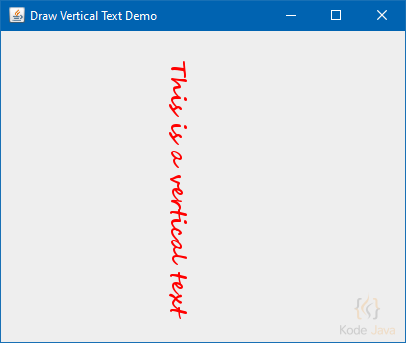
To draw a text / string vertically we need to do a transform on the Graphics2D object. First, create an instance of AffineTransform and set the rotation using the setToRotation() method. And then pass this transform object into g2.setTransform() method.

package org.kodejava.awt.geom;

import javax.swing.*;
import java.awt.*;
import java.awt.geom.AffineTransform;

public class DrawVerticalText extends JPanel {
    public static void main(String[] args) {
        JFrame frame = new JFrame();
        frame.setTitle("Draw Vertical Text Demo");
        frame.setDefaultCloseOperation(WindowConstants.EXIT_ON_CLOSE);
        frame.add(new DrawVerticalText());
        frame.pack();
        frame.setSize(420, 350);
        frame.setVisible(true);
    }

    @Override
    public void paint(Graphics g) {
        Graphics2D g2 = (Graphics2D) g;

        // Define rendering hint, font name, font style and font size
        g2.setRenderingHint(RenderingHints.KEY_ANTIALIASING, RenderingHints.VALUE_ANTIALIAS_ON);
        g2.setFont(new Font("Segoe Script", Font.BOLD, 22));
        g2.setColor(Color.RED);

        // Rotate 90 degree to make a vertical text
        AffineTransform at = new AffineTransform();
        at.setToRotation(Math.toRadians(90), 80, 100);
        g2.setTransform(at);
        g2.drawString("This is a vertical text", 10, 10);
    }
}

Run the snippet, and you’ll see the following screen:

Draw 2D Vertical Text

Draw 2D Vertical Text

How do I draw a string in Java 2D?

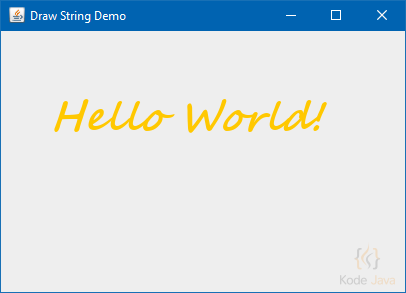
The code snippet below show you how to draw a string using Graphics2D. The drawString() method accept the string to be drawn and their x and y coordinate. Here you can also see how to set the antialiasing mode using the setRenderingHint() method.

package org.kodejava.awt.geom;

import javax.swing.*;
import java.awt.*;

public class DrawString extends JPanel {
    public static void main(String[] args) {
        JFrame frame = new JFrame();
        frame.setTitle("Draw String Demo");
        frame.setDefaultCloseOperation(WindowConstants.EXIT_ON_CLOSE);
        frame.add(new DrawString());
        frame.pack();
        frame.setSize(420, 300);
        frame.setVisible(true);
    }

    @Override
    public void paint(Graphics g) {
        Graphics2D g2 = (Graphics2D) g;

        // Define rendering hint, font name, font style and font size
        g2.setRenderingHint(RenderingHints.KEY_ANTIALIASING, RenderingHints.VALUE_ANTIALIAS_ON);
        g2.setFont(new Font("Segoe Script", Font.BOLD + Font.ITALIC, 40));
        g2.setPaint(Color.ORANGE);

        // Draw Hello World String
        g2.drawString("Hello World!", 50, 100);
    }
}

Run the snippet, and you’ll see the following screen:

Draw 2D String

Draw 2D String